

Seedream 5.0 AI Image: ByteDance’s Reasoning-First Answer to GPT Image 2
Seedream 5.0 AI image generation just introduced something most competitors still don’t have: a model that thinks before it draws. ByteDance’s Seed team unveiled the new image family at its Volcano Engine FORCE conference on June 23, 2026, positioning it directly against models like GPT Image 2 and Gemini’s image tools — not on raw resolution, but on how well it actually understands what you’re asking for.
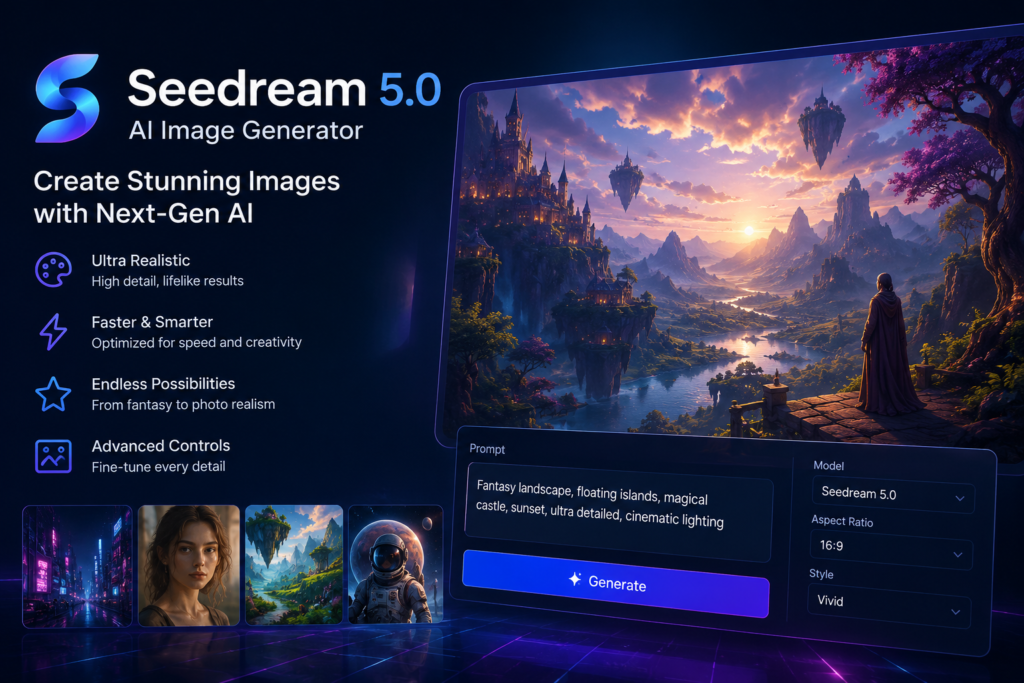
Table of Contents
Two Tiers: Pro and Lite
Unlike a single one-size-fits-all release, the Seedream 5.0 AI image model ships as two distinct tiers Seedream 5.0 Pro is the flagship, launched July 8, 2026, priced at $0.075 per image up to 2.36 megapixels and $0.150 above that threshold, with a small $0.005 charge per extra reference image. Seedream 5.0 Lite is the cost-optimized sibling, priced at roughly $0.035 per image, supporting 2K to 3K resolution.
The split matters for how you’d actually use it. Pro leans into professional-grade control — up to 10 reference images, native multilingual text, layer separation, and precision editing. Lite trades some of that ceiling for speed and reasoning depth, supporting up to 14 reference images along with sequential batch generation, which is genuinely useful if you’re building out storyboards or character sheets for a series of posts rather than a single image.
Deep Thinking Meets Live Web Search
The headline feature across both tiers of the Seedream 5.0 AI image model is what ByteDance calls ‘deep thinking’ — the model reasons through a prompt before it generates anything, working out spatial relationships, physics, and multi-step logic rather than just mapping text to pixels. Ask it for a clock face showing a specific time, or a scene with correct weight distribution on a seesaw, and it gets the details right in ways diffusion-only models frequently don’t.
Layered onto that reasoning step is real-time web search. Seedream 5.0 can pull current information — trending topics, recent events, up-to-date visual references — before it draws, which solves a problem every AI image tool has struggled with: generating content tied to something that happened after the model’s training cutoff. For creators covering fast-moving topics or timely visual trends, that’s a meaningful shift from static knowledge to live-grounded generation.
Precision Editing Without Full Re-Renders
Seedream 5.0 Pro’s editing tools go well beyond typing a new prompt and hoping for the best. You can mark a specific region using point selection, lasso, box selection, sketches, or color swatches, and the model edits only that area while keeping lighting, composition, and the rest of the frame untouched. Layer separation takes this further, splitting a single generated scene into a background layer plus individual element layers — useful if you need to swap one product, prop, or piece of clothing without regenerating everything else around it.
Seedream 5.0 Lite approaches editing differently, using example-based transformation: show it a before-and-after pair alongside a new image, and it applies the same edit logic automatically. That’s a genuinely different workflow from prompt-based editing, and it’s particularly well suited to repetitive tasks like applying one consistent style change across a batch of images.

Multilingual Text That Actually Renders Correctly
Native multilingual generation ships with the Pro tier, covering roughly a dozen widely used languages, including English, Chinese, French, German, Russian, Japanese, Korean, Spanish, and Arabic. This isn’t simple translation — architecture, facial features, and clothing are adjusted to match each language’s cultural context, which matters if you’re producing localized content rather than a single global version of the same image. Reliable text-in-image rendering has been one of the more stubborn weak points across the AI image space, so a Seedream 5.0 AI image model built specifically to handle it across multiple languages is a meaningful upgrade.
How the Seedream 5.0 AI Image Model Stacks Up and What It Costs
Seedream 5.0 isn’t trying to out-resolve every competitor — Pro tops out at 2K output, which is lower than some rivals’ maximum resolution. Its pitch is intelligence and control rather than raw pixel count: fewer hallucinated details, stronger instruction-following on complex prompts, and editing tools that don’t force a full regeneration for a small change. That positions it as a direct answer to GPT Image 2’s strengths in text rendering and prompt accuracy, aimed at creators who need reliability on complicated briefs more than they need the single highest resolution available.

At $0.075–$0.150 per image for Pro and around $0.035 for Lite, Seedream 5.0 sits in a competitive middle ground — not the cheapest option on the market, but priced to make the reasoning and editing features accessible for regular content production rather than one-off enterprise use.
Want to see how it compares directly? Check out our earlier breakdown of [GPT Image 2 vs. other AI image tools] and our recent coverage of [Seedance 2.5, ByteDance’s new video model] for more on where the Seed model family is heading.
For more breaking updates on AI tools, models, and industry news, check out our [AI News section] for the latest coverage.