

The EU AI Act Watermarking Rules Just Went Live — Here’s What Actually Changes
If you’re reading this today, the EU AI Act watermarking requirements just became enforceable, right this moment. August 2, 2026 has been circled on compliance calendars for months, and it finally arrived. If you make AI video or image content and any part of your audience is in Europe, this one actually touches you, even if you’ve never thought about EU regulation before.
Table of Contents
What Actually Kicked In Today
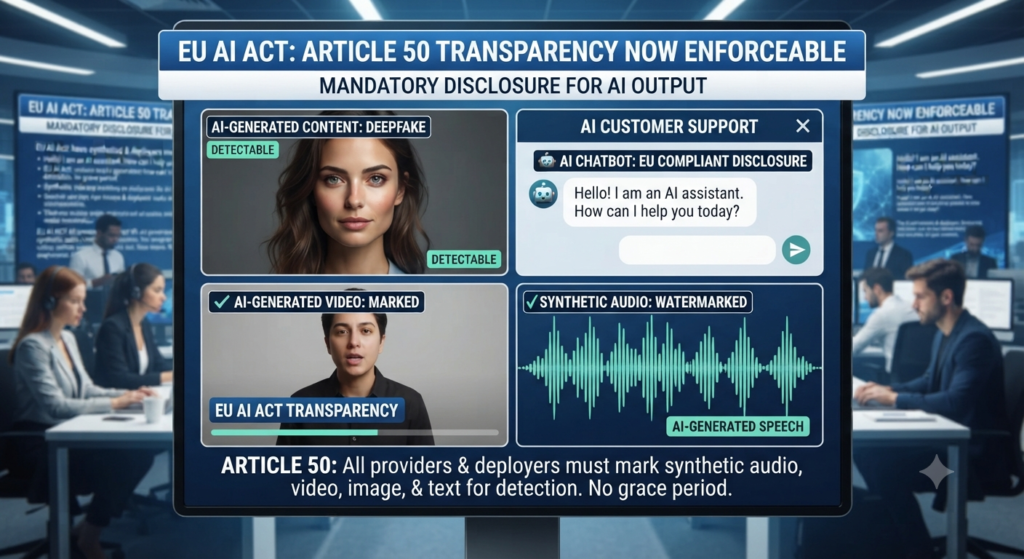
Article 50 of the EU AI Act is the transparency section, and as of today it’s fully enforceable. In plain terms: if you provide or deploy a system that generates synthetic audio, image, video, or text, that output needs to be marked in a way that makes it detectable as AI-generated. Chatbots facing the public need to disclose they’re AI right now, today, no grace period. Deepfake content needs clear disclosure. The rule applies across the board, not just to giant tech companies — it covers providers and professional deployers alike.
There’s also a fine attached that’s worth actually reading twice: up to €15 million or 3% of global annual turnover, whichever number is bigger. For a small AI-video creator that’s not really the number to worry about, but for the platforms you’re using every day, it very much is.
The Part Everyone’s Getting Wrong
Here’s the nuance about EU AI Act watermarking that a lot of the panic-headlines are missing: not everything under Article 50 starts today. The disclosure obligations — the “hey, this is AI-generated” labeling — are live now. But the machine-readable marking layer, the actual embedded watermarking and provenance metadata that gets baked into files, got pushed back to December 2, 2026 through a grace period, because the technical tooling standards genuinely weren’t ready in time.
So the practical version is: today, content needs to be disclosed as AI-generated where relevant. By December, it needs to carry actual embedded, trackable watermark data too. If you’ve seen conflicting advice about this online, that’s why — a lot of what got written before this summer had to hedge, because the final rules weren’t locked until the EU Parliament and Council signed off in June.

What EU AI Act Watermarking Actually Has to Look Like
This isn’t a single checkbox or a little “AI” badge slapped in the corner. The framework the EU landed on is layered, and it’s genuinely thorough:
- Embedded provenance data using C2PA standards — who made it, when, and with which system, baked directly into the file
- An invisible, pixel-level watermark that has to survive compression, cropping, and format conversion, not just disappear the moment someone re-exports a clip
- Fallback logging and digital fingerprinting for cases where the other two methods fall short, so content can still be traced back to its AI origin after the fact
That’s a meaningfully higher bar than most creators have been operating under, and it’s part of why the December deadline exists — this stuff takes real engineering to implement properly, not just a plugin.
What Happens If You Ignore This
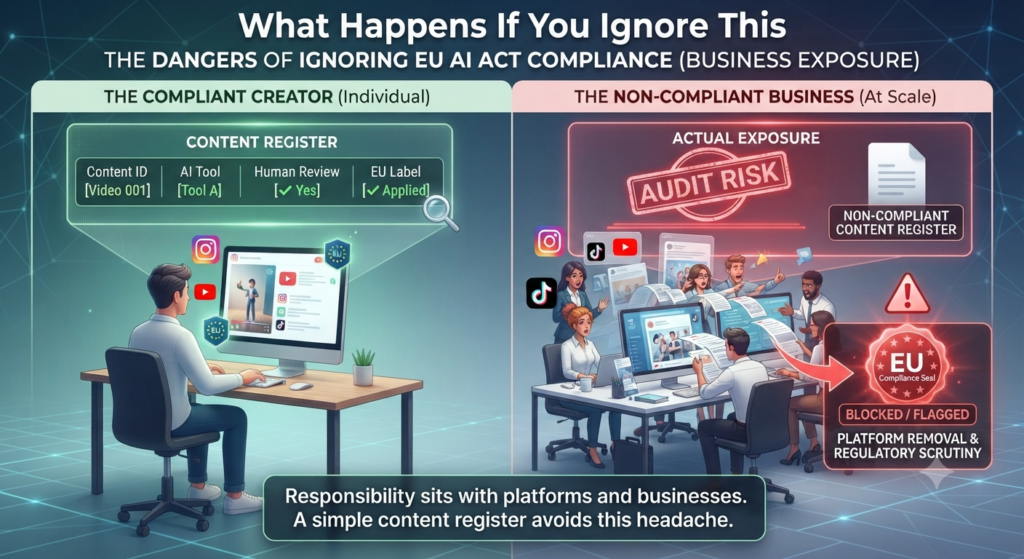
For an individual creator posting to Instagram or YouTube, nobody’s coming to fine you personally tomorrow over EU AI Act watermarking rules. The obligations and the penalties are aimed at providers (the companies building the AI models) and professional deployers (businesses using AI content at scale, especially where it touches the public). But that doesn’t mean this is irrelevant to you — it means the responsibility mostly sits one level up, with the platforms and tools you’re already using.
If your business runs AI-generated marketing or ad content at any real volume and you’re not tracking what’s disclosed and what isn’t, that’s the actual exposure. A simple content register — what was generated, what tool made it, whether a human reviewed it — is the kind of low-effort habit that saves you a real headache later.
What This Means for the Tools You Already Use
This is the part that actually matters if you’ve been following along with our other posts. Every major platform we’ve covered here is now on the hook for EU AI Act watermarking in some form. PixVerse, Seedance 2.5, Seedream 5.0, Gemini Omni Flash — all of them generate exactly the kind of synthetic media Article 50 is targeting, and the companies behind them are the ones who need to build compliant watermarking into their pipelines, not just you.
The good news is several of them are already ahead of this. Google’s models carry SynthID watermarking. ByteDance added C2PA watermarking to Seedance after its earlier copyright controversy. If a tool you’re using doesn’t mention any watermarking or provenance system at all, that’s worth a quick check before you lean on it heavily for content reaching a European audience.
Curious how this connects to what we’ve already covered? Check out our pieces on PixVerse’s rise to a $2B valuation and Seedance 2.5’s copyright system to see how these platforms have already been responding to exactly this kind of pressure.
For more breaking updates on AI tools, models, and industry news, check out our AI News section for the latest coverage.